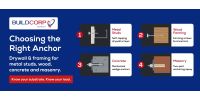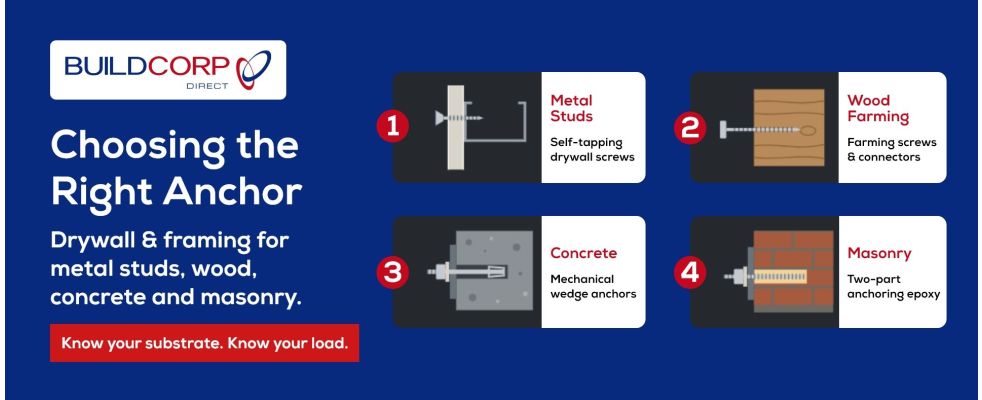
The right anchor or fastener depends on two things contractors should identify before installation: what you're fastening into, and what the connection needs to support. Drywall over metal studs, wood framing, concrete, and masonry all require different fastening solutions. Choosing correctly can help contractors avoid failed connections, rework, unnecessary supply runs, and potential inspection problems.
At Buildcorp Direct, contractors can source fastening solutions for these different substrates, from drywall self-tapping screws and framing connections to mechanical masonry anchors and two-part anchoring epoxy systems.
Why Does Choosing the Right Anchor Matter?
Using the wrong fastener can result in a connection that doesn't perform as intended. For contractors, that can mean returning to fix completed work, delaying following trades, replacing damaged materials, or addressing issues identified during inspection.
The problem often starts when fastening products are not selected based on the actual connection.
Instead, start with these questions:
- What is the substrate?
- What load will the connection carry?
- What does the specified assembly require?
A screw designed for drywall and metal framing is not automatically suitable for wood framing. Likewise, a mechanical concrete anchor and chemical anchoring system will solve two different problems.
Buildcorp Direct supplies fastening and anchoring products across various applications, helping contractors source products suited to the actual job at hand.
The right fastening decision starts with the substrate, load, and specified assembly.
What Should Contractors Use for Drywall and Metal Stud Framing?
Metal studs change the fastening equation because the screw must penetrate the steel framing behind the drywall. For this type of application, a self-drilling or self-tapping drywall screw can simplify installation by creating its own path into the metal.
The DWSDZ08258 Drywall Self Tapping Screw is designed specifically for drywall and metal fastening applications.
The important distinction is that the metal stud provides the fastening substrate. The contractor is relying on more than just the gypsum board to support the connection which is particularly important when selecting fasteners for commercial interiors where light-gauge steel framing is common.
Before installation, confirm the steel thickness, drywall configuration, required screw penetration, spacing, and project specifications. A self-drilling screw may make installation easier, but the complete assembly still determines what fastener is appropriate.
For drywall over metal framing, choose a fastener designed to penetrate and engage the metal stud.
What Should Contractors Use for Wood-to-Wood Framing Connections?
When the substrate changes, so should the fastening solution.
Wood framing connections may require more than driving a general-purpose screw through two pieces of lumber. Structural connections often use purpose-designed connectors that establish a defined load path between framing members.
Consider using the Simpson Strong-Tie A34 Framing Angle Anchor.
Simpson Strong-Tie A-series framing angles are designed for 90º connections. The manufacturer provides specified fastening schedules for its connectors. Simpson Strong-Tie A34 is identified among connectors approved for installation with specified Strong-Drive SD Connector screws.
A structural connector should be installed with the fasteners specified for that connector and application. Swapping in whatever screw happens to be available can change the performance of the connection.
For contractors, following the specified fastening schedule can help avoid rework and questions during inspection.
Wood framing connections should use purpose-designed connectors and their specified fasteners where required.
When Do Contractors Need a Mechanical Anchor for Concrete or Masonry?
Concrete and masonry introduce another different set of fastening requirements.
Instead of a screw engaging a metal stud or connector transferring loads between wood members, an anchor must develop its connection within a hard mineral substrate. For suitable applications, mechanical anchors provide a direct solution.
The Simpson Strong-Tie CSD25312 Split-Drive Anchor provides a mechanical fastening option for concrete and masonry applications.
Mechanical anchors can be useful when contractors need an efficient connection without mixing and dispensing an adhesive system. However, selecting one still requires checking the base material and application requirements.
Consider:
- Required load
- Concrete or masonry condition
- Anchor diameter and length
- Required embedment
- Edge distances and spacing
- Environmental conditions
- Project specifications
Mechanical anchors provide a practical option for many concrete and masonry connections, but selection must still reflect the substrate and required load.
When Should Contractors Consider a Chemical Anchoring System?
Some concrete and masonry applications require a different approach.
Chemical anchoring systems use an adhesive to secure threaded rod, reinforcing bar, or another anchoring element into a prepared hole. They're commonly considered where project requirements call for adhesive anchoring rather than a conventional mechanical anchor.
Buildcorp Direct's Long Pot Life Injection Epoxy 1-Gallon Resin forms the resin component of a two-part system, used with a separate hardener.
Mechanical and adhesive anchors work differently, and the appropriate system depends on the engineered connection, substrate, loads, installation conditions, and applicable specifications.
Chemical anchoring also makes installation procedure particularly important. Hole diameter and depth, hole cleaning, adhesive preparation, installation method, and cure conditions can all influence the completed connection.
For heavier-duty or specified anchoring applications, contractors should follow the relevant product documentation and project requirements.
Chemical anchors are specialized systems for applications where adhesive anchoring is required; correct product selection and installation procedure are essential.
How Do Load Requirements Change Your Fastener Choice?
Substrate is only half the decision. Two contractors could be fastening into the same concrete wall while requiring completely different anchoring systems because their loads and applications differ.
Before selecting a fastener, consider whether the connection is supporting:
- Lightweight finishes
- Framing components
- Fixtures or equipment
- Structural loads
- Static or dynamic forces
You should also consider the direction of the load. Pull-out, shear, and combined loading place different demands on a connection.
This is why Buildcorp Direct's fastening range spans products from the Drywall Self-Tapping Screw, A34 Framing Angle Anchor, Split-Drive Anchor, and Long Pot Life Injection Epoxy.
Always consider both substrate and load. The same base material can require different fastening systems for different connections.
How Do Contractors Choose the Right Anchor?
Choosing the right anchor is all about asking the right kinds of questions.
Start with the substrate. Determine the load and application. Check the specified assembly. Then choose a fastening system designed for these conditions.
For metal stud and drywall work, that could mean the DWSDZ08258 Drywall Self-Tapping Screw. Wood framing may call for a purpose-designed connector such as the Simpson Strong-Tie A34 Framing Angle Anchor. Concrete and masonry applications may use a mechanical solution like the CSD25312 Split-Drive Anchor or a specified two-part chemical anchoring system using Long Pot Life Injection Epoxy Resin.
Don't wait until you're onsite to discover you have the wrong fastener. Explore Buildcorp Direct for professional drywall, framing, concrete, and masonry fastening solutions, or contact the Buildcorp Direct team to help identify the right products for your project's substrate, application, and load requirements.