When a wall or ceiling needs better sound isolation, adding another layer of drywall is only part of the decision. How that drywall connects to the framing matters, too.
If the wallboard is rigidly connected to the studs or ceiling joists, vibration can travel through those connections. A resilient sound isolation clip helps interrupt that path by separating the drywall-supporting channel from the underlying structure.
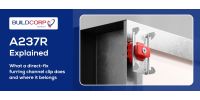
The Resilmount A237R is designed for this purpose. It attaches to the supporting structure and accepts a compatible metal furring channel, creating an isolated support system for gypsum board.
But where should it be used? How does it differ from a standard furring channel mount? And what installation details matter before you order a quantity for a project?
Here is what contractors, drywall installers and construction specifiers need to know.
What Is the Resilmount A237R?
The A237R is a direct-fix furring channel sound isolation clip manufactured by Resilmount, a Studco Building Systems brand.
It is designed for wall and ceiling assemblies where the objective is to reduce the transfer of airborne and structure-borne vibration through the building structure.
The clip includes an engineered thermoplastic rubber isolation element. Rather than relying on a completely rigid connection between the supporting structure and the drywall-supporting channel, the isolation element helps reduce vibration transfer through that connection.
The general arrangement is:
Supporting structure → A237R isolation clip → metal furring channel → gypsum board
The clip is fixed to the supporting structure. The compatible furring channel snaps into the clip, and the gypsum board is then attached to the channel using the appropriate installation method.
For the manufacturer's product information and specifications, see the Resilmount A237R product page at Buildcorp Direct.
The distinction is important: the A237R does not absorb all sound entering a room, nor does it make an entire wall soundproof on its own. It is one component in a larger acoustic assembly.
What Does a Direct-Fix Furring Channel Clip Actually Do?
To understand the A237R, it helps to look at the connection it changes.
In a conventional wall or ceiling, drywall may be attached directly to the framing or to channels that are rigidly connected to it. When sound excites the structure, vibration can travel through those connections and cause the wallboard to vibrate.
A resilient clip introduces an isolation element between the structure and the metal channel supporting the drywall.
The A237R is designed to help reduce this transfer of vibration. Its role is to provide a more isolated connection, not to eliminate every route through which sound can travel.
Three concepts are worth distinguishing.
1. Decoupling
Decoupling reduces direct mechanical connections between parts of an assembly. The A237R helps separate the drywall-supporting channel from the underlying framing.
2. Vibration Isolation
The clip's thermoplastic rubber element helps reduce vibration transfer at the connection. The result depends on the load, the surrounding materials and the complete system.
3. Sound Isolation at Assembly Level
The clip works alongside other construction elements, such as gypsum board, cavity insulation, framing and perimeter sealing. The finished assembly—not the clip alone—determines the overall acoustic performance.
Buildcorp Direct's guide on how soundproofing works explains the broader principles of decoupling, absorption, damping and mass.
Where Does the A237R Belong?
The A237R is intended for suitable wall and ceiling applications where metal furring channels are supported from the underlying structure through the isolation clips.
The manufacturer's documentation identifies wood, steel, concrete and concrete masonry unit (CMU) construction as possible substrates, subject to the appropriate fastening method and assembly requirements.
1. Walls
In a suitable wall assembly, A237R clips are fixed to the supporting framing. Metal furring channels are installed into the clips, and gypsum board is attached to the channels.
This arrangement can be useful where sound isolation between adjoining rooms is a design priority, including residential partitions, offices and other commercial interiors.
The design must account for the existing framing, wall height, board layers, channel layout and required acoustic or fire performance.
2. Ceilings
In ceiling assemblies, the clips are attached to the supporting joists or other approved substrate. The metal furring channels run perpendicular to the joists in the manufacturer's documented ceiling layout.
The gypsum board is then fixed to the channels, rather than directly to the joists.
This arrangement may be appropriate when reducing sound transmission between floors or from spaces above a ceiling is part of the project brief.
Ceiling installation deserves particular attention because the assembly carries a sustained overhead load. The specified fasteners, clip spacing, channel spacing and total dead load must all comply with the current installation instructions.
3. Renovations and Acoustic Upgrades
The A237R may be considered for renovation projects where an additional layer of supported drywall can be installed without completely rebuilding the existing assembly.
However, the clip does not remove the need to investigate other sound paths. Noise can still travel through adjoining walls, floor structures, ducts, doors and unsealed penetrations.
If those paths dominate, installing isolation clips on one surface may not deliver the expected improvement.
Where Does It Not Belong?
The A237R is not a universal fixing bracket for every wall or ceiling.
It should not be specified without checking whether the proposed assembly matches the product's intended use and installation requirements.
Be particularly careful in the following situations:
- Direct attachment of drywall to framing: The A237R is intended to support a compatible furring-channel system, not to act as a direct drywall fastener.
- Unverified channel compatibility: Check the channel dimensions and profile against the manufacturer's requirements.
- Unsupported loads: Do not assume that the clip can carry any number of drywall layers or additional fixtures. The permitted load depends on the applicable specification and layout.
- Fire-rated construction: Use the complete approved assembly and all required components. A clip's presence alone does not make a wall or ceiling fire-rated.
- Uninvestigated flanking noise: Clips cannot independently correct sound transmission through every adjoining building element.
- Non-standard fixing conditions: The fastener and substrate must be suitable for the loads and conditions of the installation.
For a project with specified STC, IIC or fire-resistance requirements, confirm the exact tested assembly rather than selecting components based only on a product description.
A237R vs A237: What Is the Difference?
The A237 and A237R are related Resilmount products, but they are not identical.
The A237 is a direct-fix furring channel mount. The A237R includes an engineered thermoplastic rubber isolation element intended to provide resilient isolation at the connection.
| Feature | A237 | A237R |
|---|---|---|
| Product type | Direct-fix furring channel mount | Resilient sound isolation clip |
| Rubber isolation element | Not included in the standard A237 design | Included |
| Intended role | Supports compatible furring channel | Supports compatible furring channel with resilient isolation |
| Application | Suitable wall and ceiling systems | Suitable wall and ceiling systems |
| Selection consideration | Confirm the required connection and assembly performance | Confirm the required isolation, load and assembly requirements |
Do not assume that changing from A237 to A237R automatically produces a particular STC improvement. Acoustic performance must be established for the complete assembly and its tested configuration.
See the A237 direct-fix furring channel mount to compare the two products before specifying one.
A237R Specifications: What Should You Check?
The manufacturer's product information identifies the A237R as compatible with 7/8-inch and 1-1/2-inch furring channels.
The published product data also identifies the following dimensions:
| Specification | Published Information |
|---|---|
| Product | Resilmount A237R |
| Clip width | 1-3/8 in |
| Clip length | Approximately 3-1/8 in |
| Clip height | Approximately 1-1/8 in, depending on the documented measurement convention |
| Rubber isolation element | Approximately 3/8 in |
| Compatible channel depths | 7/8 in and 1-1/2 in |
| Maximum clip spacing | 48 in on centre, subject to the current installation layout |
| Maximum spacing between furring channels | 24 in in the published installation guidance |
Important: Published product sheets from different dates may use different measurement conventions or load terminology. Confirm the current manufacturer's documentation before using dimensions or load figures in a specification.
For current installation details, consult the A237R installation instructions.
A237R Installation: What Matters on Site?
Correct installation is essential because an isolation clip can only perform as intended when the complete system is installed according to its design.
The following points are particularly important.
Check the Substrate and Fasteners
The clip must be attached using a fastener approved for the supporting material and the relevant load requirements.
The manufacturer's installation guide specifies different fastener types for wood, steel and concrete. Do not substitute a fastener simply because it fits through the clip.
Follow the Channel Layout
The published installation instructions specify a maximum of 48 inches on centre between clips along the furring-channel run and a maximum of 24 inches between furring channels.
These are layout limits, not a substitute for checking the actual assembly. Board layers, framing layout, load requirements and the intended application may affect the required spacing.
Avoid Rigid Sound Bridges
The isolation system should not be compromised by unintended rigid connections between the drywall-supporting channel and the framing.
Follow the manufacturer's fixing details and check any penetrations, perimeter conditions and interfaces with adjoining construction.
Seal the Perimeter
The installation guide specifies leaving a small perimeter gap around gypsum board and filling it with acoustic caulk. This helps prevent gaps from becoming an alternative sound transmission path.
The appropriate sealant and gap details should follow the relevant assembly requirements.
Confirm the Complete Assembly
Before closing the wall or ceiling, verify the clip layout, channel installation, fasteners, insulation, gypsum board and any fire-rated components.
The official Resilmount A237R installation guide should be treated as the primary reference for installation.
Does the A237R Improve STC and IIC Ratings?
The A237R is designed to help reduce vibration transfer in acoustic wall and ceiling assemblies. However, an exact improvement in Sound Transmission Class (STC) or Impact Insulation Class (IIC) cannot be assigned to the clip in isolation.
STC describes a partition's ability to reduce airborne sound transmission under a standardised test. IIC is used to evaluate impact-sound insulation in floor-ceiling assemblies.
The result depends on the complete tested construction, including the framing, board layers, insulation, channel arrangement, fastening and other details.
For example, a tested floor-ceiling system using A237R clips may have a different rating from a wall assembly using the same clips. Those results should not be treated as interchangeable.
Where a project specification requires a particular rating, use the manufacturer's applicable tested assembly documentation or obtain advice from an acoustic consultant.
How Many A237R Clips Do You Need?
Clip quantities depend on the dimensions of the wall or ceiling, the spacing between framing members, the furring-channel layout and the applicable installation requirements.
The manufacturer's July 2024 installation guide includes a planning estimate of approximately one clip per 4.5 square feet for the illustrated 24-inch-by-48-inch layout. This is a preliminary estimating reference, not a universal quantity for every project.
Before ordering, confirm the actual layout and account for perimeter positions, channel runs, framing centres and any project-specific requirements.
For larger orders, use the A237R product page at Buildcorp Direct to review the product information and purchasing options.
Is the A237R Right for Your Project?
The A237R is worth considering when a wall or ceiling design calls for a resilient connection between the building structure and the metal channel supporting the gypsum board.
It is not automatically the right choice for every soundproofing project.
| Project Requirement | What to Do |
|---|---|
| Reduce vibration transfer through a wall or ceiling connection | Evaluate an appropriate resilient clip assembly |
| Meet a specified STC or IIC rating | Select a documented tested assembly |
| Improve sound isolation during renovation | Check available depth, framing, load and other transmission paths |
| Install overhead drywall | Confirm the permitted load and fastening requirements |
| Meet fire-resistance requirements | Follow the exact approved fire-rated assembly |
| Choose between A237 and A237R | Compare the required connection type and isolation needs |
The main decision is not simply whether the A237R is a good clip. It is whether the product is appropriate for the assembly you are building.
Final Takeaway
The Resilmount A237R is a direct-fix furring-channel sound isolation clip designed to help reduce vibration transfer between a building structure and the channel supporting gypsum board.
It belongs in compatible, properly designed wall and ceiling assemblies—not as a standalone soundproofing solution.
Before specifying it, confirm the substrate, furring-channel compatibility, load requirements, spacing, fasteners and any acoustic or fire-rated assembly requirements.
For projects where the A237R is appropriate, start with the Resilmount A237R at Buildcorp Direct and use the manufacturer's current installation documentation to finalise the design.
FAQ
What does an A237R clip do?
It supports a compatible metal furring channel while introducing a resilient isolation element between the channel and the underlying structure, helping reduce vibration transfer.
Can the A237R be used on walls and ceilings?
Yes. The manufacturer's documentation covers suitable wall and ceiling assemblies, subject to the applicable installation layout, loads and fixing requirements.
What furring channels are compatible with the A237R?
The published product information identifies 7/8-inch and 1-1/2-inch furring channels. Confirm the channel profile and dimensions against the current manufacturer's specifications.
What is the difference between A237 and A237R?
The A237R includes an engineered thermoplastic rubber isolation element, while the standard A237 does not have the same resilient element.
Does the A237R guarantee a particular STC rating?
No. STC and IIC results apply to complete tested assemblies. The clip alone cannot guarantee a specific acoustic rating.
Can I use any screw to install the A237R?
No. Use fasteners suitable for the substrate and approved under the manufacturer's installation instructions and applicable load requirements.
Does installing A237R clips make a ceiling fire-rated?
Not by itself. Fire resistance depends on the complete approved assembly and the required components and installation details.