
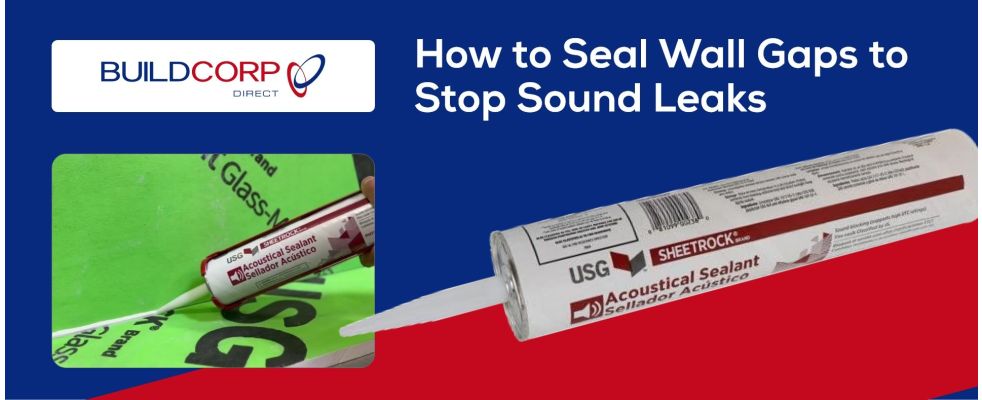
Sound leaks through small gaps in walls, even in well-built spaces. Sealing these gaps with acoustic sealant is one of the easiest ways to reduce noise transfer. Using a product like the USG Acoustical Sealant 29oz Tube at Buildcorp Direct helps block sound while staying flexible over time.
Why Do Small Gaps in Walls Cause Big Sound Problems?
Sound travels through air and structure. If air can pass through a gap, sound can too.
Even tiny openings weaken soundproofing. A gap as small as 1% of a wall surface can allow up to 50% of sound to pass through.
This is why sealing gaps is one of the first steps in soundproofing.
Using the USG Acoustical Sealant helps create an airtight barrier that stops these leaks.
Even small gaps allow large amounts of sound through, making acoustic sealing essential.
Where Are the Most Common Sound Leaks in Walls?
Sound leaks happen in predictable areas. Contractors check these areas first.
Common Locations:
- Wall-to-floor joints
- Wall-to-ceiling joints
- Around electrical outlets and switches
- Window and door frames
- Pipe, cable, and duct penetrations
- Drywall seams and corners
These areas often look sealed but still allow airflow.
Acoustic sealant is designed specifically for these problem zones. The USG Acoustical Sealant can be applied across all of these locations to improve sound isolation.
Sound leaks typically occur at joints, penetrations, and wall edges.
What Is Acoustic Sealant and How Does It Stop Sound Leaks?
Acoustic sealant is a flexible material designed to block sound transmission.
Unlike standard caulk, it stays soft and pliable over time. This prevents cracking and maintains an airtight seal.
It works by:
- Filling gaps and cracks
- Blocking airflow paths
- Reducing vibration at joints
- Maintaining flexibility as structures move
The USG Acoustical Sealant is specifically designed for these applications, making it ideal for both residential and commercial soundproofing.
Acoustic sealant blocks sound by sealing gaps and staying flexible long term.
How Do You Prepare Walls Before Sealing Gaps?
Preparation is essential for good performance. Poor surface preparation reduces adhesion and effectiveness.
Preparation Steps:
- Clean surfaces to remove dust and debris
- Ensure the area is completely dry
- Remove old caulk or loose material
- Inspect for hidden gaps or cracks
- Use tape if clean edges are required
Clean surfaces allow the sealant to bond properly and last longer.
Once prepared, apply the USG Acoustical Sealant immediately for best results.
Clean, dry surfaces ensure proper adhesion and long-term sealing performance.
How Do You Apply Acoustic Sealant to Stop Sound Leaks?
Applying acoustic sealant is simple and requires basic tools.
Application:
- Load the USG Acoustical Sealant 29oz Tube into a caulking gun
- Cut the nozzle at a 45º angle
- Apply a steady, continuous bead
- Fill the entire gap fully
- Smooth the bead for better contact
Apply evenly and avoid breaks in the seal.
Acoustic sealant works best when applied as a continuous barrier across all joints.
Apply a continuous bead of sealant to fully close gaps and prevent sound leaks.
How Effective is Sealing Gaps for Soundproofing?
Sealing gaps is one of the most cost-effective soundproofing methods. It improves overall system performance by eliminating weak points. Without sealing, even high-end materials lose effectiveness.
Benefits:
- Reduces airborne sound transfer
- Improves privacy between rooms
- Enhances performance of insulation and drywall
- Prevents flanking noise paths
Acoustic sealant is considered an essential step in soundproofing systems.
Sealing gaps significantly improves overall soundproofing performance.
What Mistakes Should You Avoid When Sealing Gaps?
Even simple sealing jobs can fail if key steps are missed.
Common Mistakes:
- Skipping surface cleaning
- Using standard caulk instead of acoustic sealant
- Applying too little sealant
- Leaving gaps or breaks in the bead
- Not sealing all problem areas
Acoustic sealant must be applied fully and correctly in order to be effective.
The USG Acoustical Sealant is designed for consistent application, helping reduce these risks.
Proper application and full coverage are essential for effective sound sealing.
Can You Combine Acoustic Sealant with Other Soundproofing Methods?
You absolutely can combine acoustic sealant with other soundproofing methods. Acoustic sealant actually works best as part of a larger system.
Combine with:
- Additional drywall layers
- Sound-damping compounds
- Insulation upgrades
- Door and window sealing
Soundproofing follows a system approach. Sealing gaps supports all other methods. Without sealing, sound can bypass even the best materials.
Acoustic sealant enhances the effectiveness of all other soundproofing methods.
Is Sealing Gaps Worth It?
Sealing gaps is one of the simplest and most effective ways to reduce sound leaks. It addresses the weakest points in wall systems and improves overall performance.
Acoustic sealant provides long-term flexibility, durability, and reliable results. It's a practical solution for both contractors and homeowners.
The USG Acoustical Sealant is a professional grade option that delivers consistent soundproofing performance across a wide range of applications.
If you want to stop sound leaks at the source, start with the USG Acoustical Sealant 29oz Tube from Buildcorp Direct. It's an easy, effective upgrade that helps you seal gaps, reduce noise, and improve comfort in any space without major construction.


